
|
#1 - 5/29/2026 - A section of the Walls of Lucca, a historic fortification system located in Tuscany, Italy. Originally built between 1504 and 1648, these Renaissance-era walls are exceptionally well-preserved and completely encircle the city's historic center. The top of the wall, pictured here, has been converted into a wide, tree-lined promenade popular for walking and cycling.
|
|

|
#2 - 5/29/2026 - Holt and Amanda take a stroll around the Renaissance-era walls surrounding the city of Lucca in Tuscany, Italy. These walls were originally constructed for military defense between the 16th and 17th centuries, though they never saw active military use. In the 1820s, the ramparts were converted into a public promenade and park, which is still popular for walking and cycling today. The walls are exceptionally well-preserved and feature a circumference of over 4 kilometers (2.5 miles), making them one of the best-preserved examples of Renaissance fortifications in Europe.
|
|

|
#3 - 5/29/2026 - Holt and Joe A. take a stroll around the Renaissance-era walls surrounding the city of Lucca in Tuscany, Italy. These walls were originally constructed for military defense between the 16th and 17th centuries, though they never saw active military use. In the 1820s, the ramparts were converted into a public promenade and park, which is still popular for walking and cycling today. The walls are exceptionally well-preserved and feature a circumference of over 4 kilometers (2.5 miles), making them one of the best-preserved examples of Renaissance fortifications in Europe.
|
|

|
#4 - 5/29/2026 - The Porta San Gervasio, an historic medieval gate in Lucca, Italy. It was built in the 13th century as part of the city's second set of defensive walls. Today, the gate is situated entirely within the larger, outer Renaissance walls. The structure is located directly adjacent to the Hotel Ilaria, which is housed in restored buildings next to the gate.
|
|

|
#5 - 5/29/2026 - A narrow, historic street in the town of Lucca, located in the Tuscany region of Italy. The street is characterized by tall, aged buildings with traditional green shutters and stone-paved walkways. The area is a popular tourist destination known for its intact Renaissance-era walls and charming labyrinthine alleyways.
|
|

|
#6 - 5/29/2026 - The Romanesque-style Santa Maria Forisportam church in Lucca, Italy, which was historically situated outside the city's Roman walls. Also known as Santa Maria Bianca due to its white limestone facade, it features an unfinished exterior and a bell tower added in 1619. The architecture of this 12th-century church is modeled after the Cathedral of Pisa. Located in the Piazza Santa Maria Forisportam, the site is surrounded by outdoor cafes like Caffetteria La Colonna.
|
|

|
#7 - 5/29/2026 - The Romanesque-style Santa Maria Forisportam church in Lucca, Italy, which was historically situated outside the city's Roman walls. Also known as Santa Maria Bianca due to its white limestone facade, it features an unfinished exterior and a bell tower added in 1619. The architecture of this 12th-century church is modeled after the Cathedral of Pisa. Located in the Piazza Santa Maria Forisportam, the site is surrounded by outdoor cafes like Caffetteria La Colonna.
|
|

|
#8 - 5/29/2026 - A narrow street leading to he iconic Guinigi Tower in Lucca, Italy, a medieval brick tower renowned for the oak trees planted on its roof. The tower is situated in the heart of Lucca's historic center. Holm oak trees grow from the top, serving as a symbol of rebirth. The structure rises roughly 44-45 meters (144-148 feet) high. It was built in the 14th century by the wealthy Guinigi family.
|
|

|
#9 - 5/29/2026 - The iconic Guinigi Tower in Lucca, Italy, a medieval brick tower renowned for the oak trees planted on its roof.Location: The tower is situated in the heart of Lucca's historic center.Key Feature: Holm oak trees grow from the top, serving as a symbol of rebirth.Dimensions: The structure rises roughly 44-45 meters high.History: It was built in the 14th century by the wealthy Guinigi family.
|
|

|
#10 - 5/29/2026 - Holt and Amanda in the interior of the historic Guinigi Tower in Lucca, Italy, a 700-year-old stone and brick structure. The tower was constructed in the early 1300s and features a unique garden with oak trees at its summit. Visitors climb narrow stairs, sometimes barely a foot wide, to reach the top for views of the city. The structure is a popular landmark in Lucca, originally gifted to the city by the last descendants of the Guinigi family.
|
|

|
#11 - 5/29/2026 - A grated window in the historic Guinigi Tower in Lucca, Italy, a 700-year-old stone and brick structure. The tower was constructed in the early 1300s and features a unique garden with oak trees at its summit. Visitors climb narrow stairs, sometimes barely a foot wide, to reach the top for views of the city. The structure is a popular landmark in Lucca, originally gifted to the city by the last descendants of the Guinigi family.
|
|

|
#12 - 5/29/2026 - The winding staircase leading up to the top of the Torre Guinigi in Lucca, Italy, a 14th-century tower famous for the holm oak trees growing on its roof. Visitors can climb the 232 steps to the top to see the rooftop garden and views of the city. The tower is a distinctive symbol of Lucca, representing the power of the Guinigi family.
|
|

|
#13 - 5/29/2026 - This is where the following aerial panoramic pictures were taken from, the top of the Torre Guinigi in Lucca, Italy, a 14th-century tower famous for the holm oak trees growing on its roof. Visitors can climb the 232 steps to the top to see the rooftop garden and views of the city. The tower is a distinctive symbol of Lucca, representing the power of the Guinigi family.
|
|

|
#14 - 5/29/2026 - Amanda, Holt and Joe A. at the location where the following aerial panoramic pictures were taken from, the top of the Torre Guinigi in Lucca, Italy, a 14th-century tower famous for the holm oak trees growing on its roof. Visitors can climb the 232 steps to the top to see the rooftop garden and views of the city. The tower is a distinctive symbol of Lucca, representing the power of the Guinigi family.
|
|

|
#15 - 5/29/2026 - Joe A., Amanda and Holt at the location where the following aerial panoramic pictures were taken from, the top of the Torre Guinigi in Lucca, Italy, a 14th-century tower famous for the holm oak trees growing on its roof. Visitors can climb the 232 steps to the top to see the rooftop garden and views of the city. The tower is a distinctive symbol of Lucca, representing the power of the Guinigi family.
|
|

|
#16 - 5/29/2026 - Amanda and Holt at the location where the following aerial panoramic pictures were taken from, the top of the Torre Guinigi in Lucca, Italy, a 14th-century tower famous for the holm oak trees growing on its roof. Visitors can climb the 232 steps to the top to see the rooftop garden and views of the city. The tower is a distinctive symbol of Lucca, representing the power of the Guinigi family.
|
|

|
#17 - 5/29/2026 - Holt and Joe A. on the top of the historic Guinigi Tower in Lucca, Italy, a 700-year-old stone and brick structure. The tower was constructed in the early 1300s and features a unique garden with oak trees at its summit. Visitors climb narrow stairs, sometimes barely a foot wide, to reach the top for views of the city. The structure is a popular landmark in Lucca, originally gifted to the city by the last descendants of the Guinigi family.
|
|

|
#18 - 5/29/2026 - A spectacular panoramic view of the historic town of Lucca, Italy from the top of the historic Guinigi Tower.
|
|
|
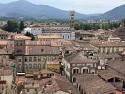
#19 - 5/29/2026 - A view of the historic city center of Lucca, Italy, in the region of Tuscany. The prominent landmark with the bell tower in the background is the Lucca Cathedral (Cattedrale di San Martino). The architecture features characteristic terracotta roof tiles throughout the medieval town.
|
|

|
#20 - 5/29/2026 - A scenic, elevated view of the historic city of Lucca in Tuscany, Italy, looking out from a high vantage point like the Guinigi Tower. The skyline is dominated by numerous ancient buildings featuring distinctive terracotta red-tiled roofs, a hallmark of the city's medieval architecture. Visible landmarks include the Torre delle Ore (Clock Tower) and other medieval towers set against the backdrop of distant mountains. The scene highlights the preserved, dense urban layout of Lucca, known for its intact Renaissance-era city walls and historic center.
|
|

|
#21 - 5/29/2026 - An aerial view looking over the terracotta rooftops of Lucca, Italy. The prominent tower with a clock visible in the scene is the Torre delle Ore (Clock Tower). The image was taken from the top of the nearby Torre Guinigi, famous for the oak trees planted on its summit
|
|

|
#22 - 5/29/2026 - A spectacular panoramic view of the historic town of Lucca, Italy from the top of the historic Guinigi Tower. The city is famous for its nearly 100 churches, cobbled streets, and distinctive terracotta-roofed architecture. Notable landmarks visible often include the Guinigi Tower, recognized for the mature trees growing on its rooftop.
|
|

|
#23 - 5/29/2026 - The historic city center of Lucca, Italy, from above with the prominent tower of the Basilica of San Frediano visible in the center, the Apuan Alps can be seen framing the city.
|
|

|
#24 - 5/29/2026 - A spectacular panoramic view of the historic town of Lucca, Italy from the top of the historic Guinigi Tower. The city is famous for its nearly 100 churches, cobbled streets, and distinctive terracotta-roofed architecture. Notable landmarks visible often include the Guinigi Tower, recognized for the mature trees growing on its rooftop.
|
|

|
#25 - 5/29/2026 - The historic city center of Lucca, Italy, from above with the prominent tower of the Basilica of San Frediano visible in the center, the Apuan Alps can be seen framing the city.
|
|

|
#26 - 5/29/2026 - The historic city center of Lucca, Italy, from above with the prominent tower of the Basilica of San Frediano visible in the center, the Apuan Alps can be seen framing the city.
|
|

|
#27 - 5/29/2026 - The Piazza dell'Anfiteatro in Lucca, Italy, a public square famous for its unique elliptical shape. The surrounding buildings were constructed directly upon the ruins of a 1st or 2nd-century Roman amphitheater. Visitors can enter the square through four distinct gateways located at the vertices of the ellipse. The central area, once the arena floor, is now lined with numerous outdoor cafes and restaurants.
|
|

|
#28 - 5/29/2026 - The Basilica di San Frediano, a historic Romanesque church located in Lucca, Tuscany, Italy. The facade is notable for its large 13th-century mosaic depicting the Ascension of Christ, situated above a series of arched windows. It is considered one of the oldest places of worship in the city and is famous for its Lombard-style architecture.
|
|

|
#29 - 5/29/2026 - The Basilica di San Frediano, a historic Romanesque church located in Lucca, Tuscany, Italy. The facade is notable for its large 13th-century mosaic depicting the Ascension of Christ, situated above a series of arched windows. It is considered one of the oldest places of worship in the city and is famous for its Lombard-style architecture.
|
|

|
#30 - 5/29/2026 - The historic bell tower of the Basilica of San Frediano in Lucca, Italy. The tower is situated within a narrow, medieval street in the city's historic center. The buildings flanking the alleyway are characteristic of Tuscan architecture, featuring residential apartments with shuttered windows.
|
|

|
#31 - 5/29/2026 - The Romanesque-style Chiesa di San Salvatore in Mustiolo in Lucca, Tuscany. While documented since the 11th century, the current structure primarily dates from a 12th-century reconstruction. The facade features distinct stone masonry on the lower half and yellow-toned plaster on the upper portion, along with a prominent arched entrance.
|
|

|
#32 - 5/29/2026 - Inside the Romanesque-style Chiesa di San Salvatore in Mustiolo in Lucca, Tuscany. While documented since the 11th century, the current structure primarily dates from a 12th-century reconstruction. The facade features distinct stone masonry on the lower half and yellow-toned plaster on the upper portion, along with a prominent arched entrance.
|
|

|
#33 - 5/29/2026 - The main altar of the Romanesque-style Chiesa di San Salvatore in Mustiolo in Lucca, Tuscany. The main altar features a 14th-century wooden crucifix. Below the altar lies a reclining statue of a saint, and the structure is flanked by two prominent statues of figures holding candelabras .The church is historically known as the Church of the Misericordia due to its proximity to the former ambulance service building.
|
|

|
#34 - 5/29/2026 - The Fontana della Pupporona located in Piazza del Salvatore in Lucca, Italy. The fountain was designed by architect Lorenzo Nottolini and features a statue of a Naiad sculpted by Luigi Comolli in 1842. The statue earned its local nickname ("Pupporona") due to the prominent exposure of one breast. It is situated in the historic center of Lucca, near the Cenami Palace.
|
|

|
#35 - 5/29/2026 - The San Michele in Foro church located in Lucca, Tuscany, Italy. The structure is a prime example of Pisan Romanesque architecture, recognizable by its highly decorative facade featuring multiple tiers of columns and arches. It was built over the site of an ancient Roman forum, which inspired its name.
|
|

|
#36 - 5/29/2026 - The Roman Catholic basilica San Michele in Foro located in Lucca, Tuscany, Italy. It was built over the ancient Roman forum and is dedicated to the Archangel Michael. The façade features 13th-century sculptures and inlays, many of which were remade in the 19th century. The church is famous for its intricate architecture, large arched entrance, and a statue of St. Michael at the very top.
|
|

|
#37 - 5/29/2026 - The side of the San Michele in Foro church, a Roman Catholic basilica located in Lucca, Tuscany, Italy. The piazza in front of the church, Piazza San Michele, is hosting a promotional setup for the footwear "designed for children" by brand Lelli Kelly. The setup includes pink flooring, umbrellas, and balloon decorations arranged in the historic square.
|
|

|
#38 - 5/29/2026 - Amanda and Holt (in the foreground) walking inside the interior of the Church of San Michele in Foro located in Lucca, Tuscany, Italy. The basilica features Romanesque architecture, highlighted by its distinctive vaulted ceiling and grand columns. Historically, the church stands on the site of the ancient Roman Forum, which gives it its name.
|
|

|
#39 - 5/29/2026 - The interior of the Chiesa di San Michele in Foro in Lucca, Italy. The prominent central feature is the ornate pulpit. The church is a noted example of Tuscan Romanesque architecture.
|
|

|
#40 - 5/29/2026 - This 1867 painting depicts Saint Philomena flanked by two angels, located within the Church of San Michele in Foro in Lucca, Italy. The artwork was painted by Stefano Lembi. It portrays St. Philomena of Rome, a 4th-century virgin and martyr, holding a lily and palm fronds.
|
|

|
#41 - 5/29/2026 - This framed painting depicts Joan of Arc in armor holding a banner, situated within the Church of San Michele in Foro in Lucca, Italy. The artwork is positioned within a structured altar featuring dark marble columns and a detailed pediment. The scene includes surrounding figures of saints and angels in the composition.
|
|

|
#42 - 5/29/2026 - Looking towards the rear of the interior of the Basilica of San Michele in Foro in Lucca, Italy. The church is located in the former Roman forum of the city. It is a prime example of Tuscan Romanesque architecture. The interior is known for being relatively dim and moody.
|
|

|
#43 - 5/29/2026 - The bronze statue of Francesco Carrara, an Italian jurist and politician known for his work in criminal law and advocating for the abolition of the death penalty. The monument was created by sculptor Augusto Passaglia and is located in the courtyard of the Palazzo Ducale in Lucca, Italy. The statue depicts Carrara sitting in a chair atop a tall pedestal within the central court of the 16th-century palace.
|
|

|
#44 - 5/29/2026 - A panoramic view of Piazza Napoleone in Lucca, Italy, an historic square in the city center. The square features a prominent statue of Maria Luisa di Borbone. It is surrounded by historic buildings and tree-lined avenues. A carousel is often located in this piazza.
|
|

|
#45 - 5/29/2026 - The marble statuary group is the Monument to Maria Luisa di Borbone, located in the center of Piazza Napoleone in Lucca, Italy. The sculpture was created by Lorenzo Bartolini to honor the former Duchess of Lucca after her death in 1824. It depicts the Duchess holding a roll of paper and a staff, accompanied by a young boy holding a cornucopia. The statue is situated in front of the Palazzo Ducale within the large, historic rectangular square.
|
|
 Back to Slide Shows Menu
 Go to Home Page
 Email Us